
How to calculate the cost of a leader's risks

A company’s dependence on its founder feels like a strength. Yet it works like hidden fragility. Take this 10-question test to see how well a business runs without its founder. It also shows what that dependence costs you — both when you sell and in your own freedom.
The Basic Formula
Cost of a leader’s risk = probability of occurrence × size of the potential loss × management share
Probability of occurrence — how likely the risk is to materialize and/or recur.
Size of the potential loss — money, time, clients, people, reputation, mandate, or a market opportunity.
Management share — how much of the fallout traces back to the leader’s decisions, actions, or inaction.
For example, a project is delayed by two months, and the total cost of that delay is $150,000. On review, it becomes clear that a substantial share (~50%) of the delay traces back to the top executive’s late decisions, constant re-approvals, and the team’s lack of clear authority.
Risk estimate: $150,000 × 50% = $75,000.
Where to Find the Cost of Risk
1. Time
Time is one of the most common hidden costs of management risk. You can measure it through delayed decisions, pushed-back deadlines, missed market windows, repeated meetings, and time spent waiting on approvals.
Example: Eight executives each spend two hours a week re-discussing a decision that never gets locked in. The average cost of an hour is $100.
8 × 2 × $100 × 12 weeks = $19,200.
And that is only the cost of the time — before factoring in the project delay and the lost momentum.
2. People
A leader’s risk often surfaces as overload, demotivation, and the departure of strong performers. Worth counting here: the cost of finding a replacement, onboarding, lost expertise, a dip in results, and the added strain on the remaining team.
Example: The commercial director leaves, and finding and onboarding a replacement takes five months. Sales over that period drop by $190,000. Recruitment and temporary team reinforcement cost $25,000. Direct cost of the risk: $215,000.
If the reason for leaving was a lack of real authority, the risk is rooted in how the management system itself is built.
3. Money
This is where you count the direct financial consequences: lost revenue, shrinking margins, penalties, budget overruns, the cost of rework, and inefficient investments.
Example: A problem with a contractor was escalated too late. Two months on, the project had to be redone. Additional budget: $112,000. Fixing it early would have cost $25,000. The price of the late decision: $87,000.
4. Reputation
Reputational damage can be measured through its consequences: lost deals, eroded partner trust, longer negotiations, a higher cost of acquiring clients, and strong candidates turning you down.
Example: After a failed product launch, two major clients put negotiations on hold for a quarter. The potential gross profit was $250,000. Before the incident, the probability of closing was estimated at 60%. Expected loss: $250,000 × 60% = $150,000.
5. Authority
One of a leader’s most valuable assets, authority erodes in ways that are easy to spot: extra layers of approval, smaller budgets for initiatives, narrowed mandates, and tighter oversight from the board, owners, or investors.
Example: After a series of contested decisions, the top executive’s new initiatives now go through an extra round of approval. The project launch cycle stretches from three months to six. Over the year, the company misses two market windows, each with an expected margin of $310,000.
Estimated cost of a weakened mandate: up to $620,000 in potential profit.
How to Determine the Management Share
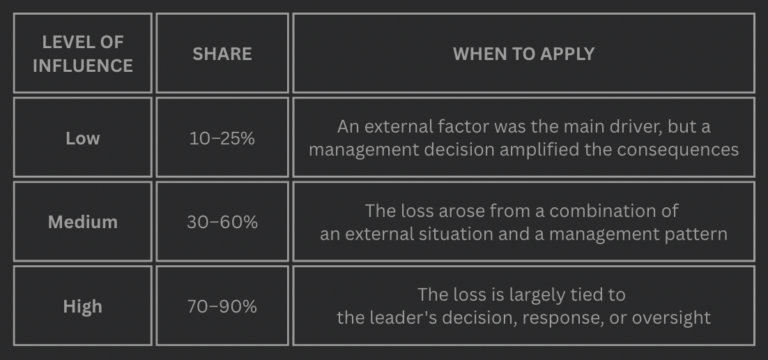
Not every loss should be pinned entirely on the leader. A business is shaped by the market, competitors, the team, regulation, capital, and the external environment. Even so, it helps to isolate the management share. This approach makes it possible to discuss risk concretely, without assigning blame:
What to Do After the Calculation
The number exists to drive a decision.
If a risk costs the business $6,000 a year, monitoring it may be enough. If the price of the risk is $125,000–$250,000, it calls for a management framework: checkpoints, escalation rules, independent review of decisions, a reassessment of authority, and a change in who is involved.
For every costly risk, it is worth pinning down:
- which mechanism creates the loss;
- where the early signals appear;
- who owns the decision;
- what protective measure needs to be put in place;
- how quickly the effect needs to be checked.
A leader’s risks can be measured through money, time, people, reputation, and mandate. What matters most is tying the loss to a specific management mechanism: late escalation, decisions concentrated in one person’s hands, information filters, weak team authority, the wrong tempo, or a business overly dependent on its top executive.
Once a risk is quantified, it becomes a management fact. It can be reduced, contained, reassessed, and built into a system that keeps a career — or a business — under control.
Related material:
«Personal Risk Management»