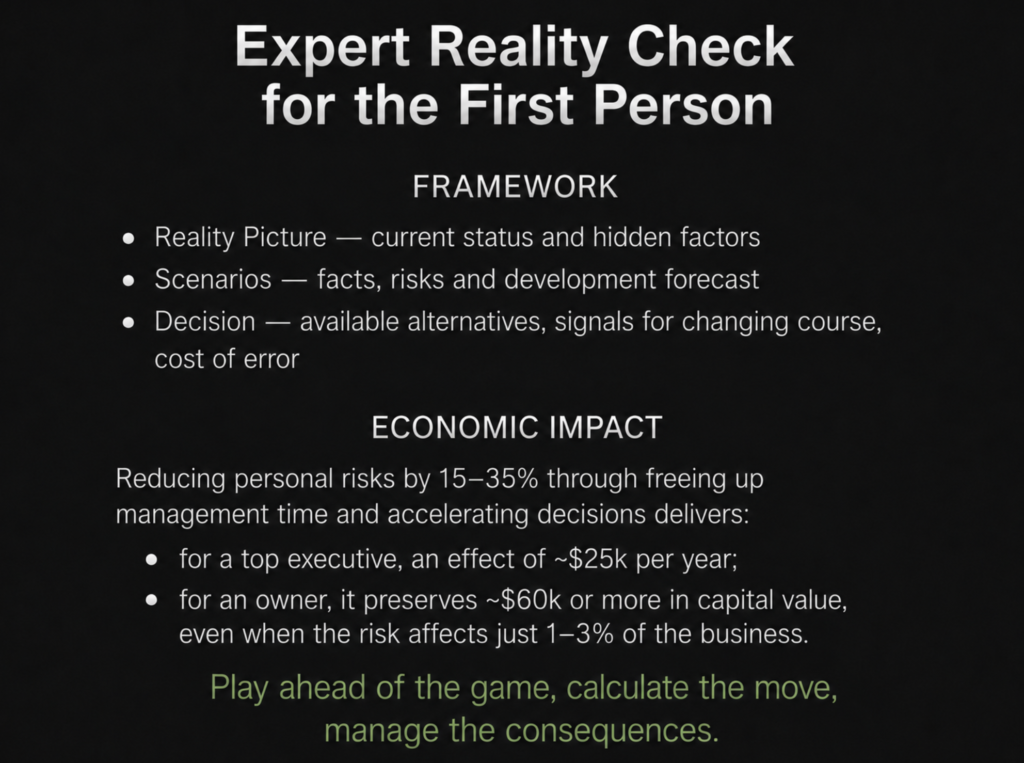
Personal Risk Matrix:
The Vista TFS Method

Strategic Risk Domains
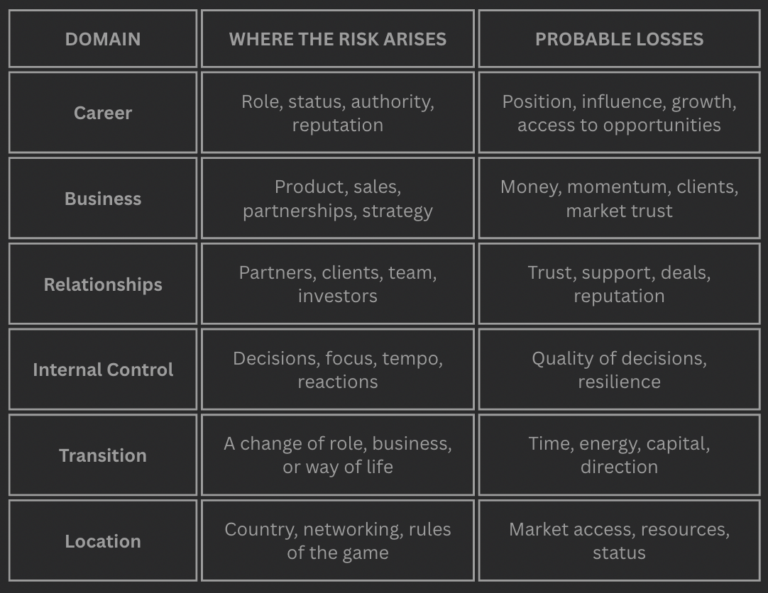
The Vista TFS Method
Often, risks have not yet materialized. Sometimes only the first signs of a potential loss appear — repeated failures, system instability. Even then, the matrix helps detect these signs in advance.
The matrix is built along two axes.
The first is the zone of possible loss.
The second is the mechanism through which the risk plays out.
As a result, you get a map. It shows not only “what could go wrong,” but also the management mechanism behind it.
Risk Zones and Assets in the Vista TFS Method
We work with three areas where a leader stands to lose:
- Finances
- Status
- Reputation
Our expertise confirms several patterns.
- First, finances suffer when a leader sees reality poorly, misjudges risk, or builds the business around themselves.
- Next, status weakens when a leader loses authority and can no longer hold the system together without hands-on control.
- Finally, reputation erodes when observers notice a recurring pattern: late reactions, impulsiveness, and a decline in decision quality.
We examine personal risk through four of a leader’s key assets.
To begin with, effectiveness is the ability to deliver results within a specific system, with its own culture, resources, constraints, and team maturity.
Relationship capital, in turn, is the trust and working ties with key people, clients, and the team.
Career position means access to the next level of role or influence — the room to drive change, allocate resources, and shape direction.
Business standing, finally, is how the leader is perceived in the market, inside the company, and among partners and investors.
Personal risk arises when one of these assets begins to weaken. The cause may lie in an external situation. More often, though, the mechanism is hidden in management style, the response to pressure, the choice of allies, and the attitude toward mistakes. Recurring situations and repeated lapses in judgment are especially telling.
An Example of the Matrix in Action
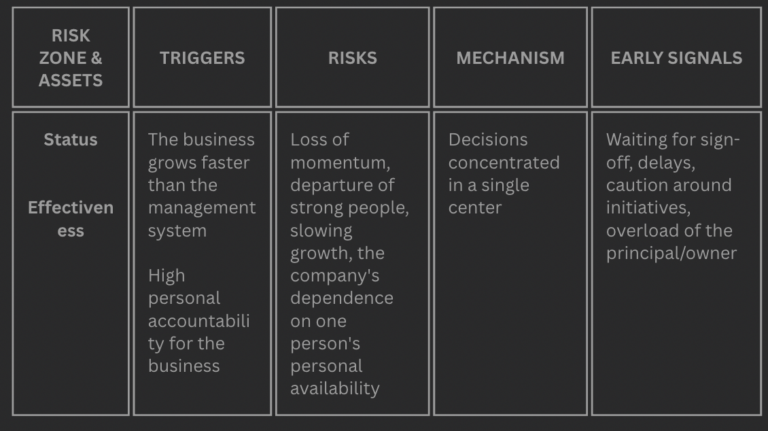
Imagine a leader who built their company by being personally involved in every key decision. Early on, this brought speed, precision, and quality control. Then the company grew. New functions appeared, partnerships became more complex, and management layers multiplied.
Gradually, the signals emerge:
- the team waits for the leader’s final word even on matters within its own remit;
- initiatives stall whenever the leader is unavailable;
- strong managers grow weary of their limited authority;
- some decisions get discussed off the record;
- new projects launch more slowly than the market demands.
In conventional terms, this looks like a team that lacks independence. In the Vista TFS matrix, however, the picture is broader.
How to Use the Matrix
The matrix is useful in three situations.
First, before an important decision — for instance, before changing strategy, launching a new business, switching companies, or entering a partnership.
Second, after a recurring failure, when a problem keeps returning in different forms: missed deadlines, conflicts, people leaving, and late escalation.
Third, at a moment of career or business transition, when a leader moves to a new level of scale, role, or visibility.
The practical sequence is straightforward.
- Begin by identifying the key decision or the recurring problem.
- Then locate the zone of possible loss: influence, reputation, relationships, career position, or business standing.
- Next, describe the mechanism through which the risk could materialize.
- After that, capture the early signals and calculate the cost.
- Finally, choose a protective measure: revisiting the decision, an extra check, an outside perspective, a change to the escalation framework, or clearer agreements.
In practice, this approach supports advancing a career, building a business, entering a new market, and changing professional direction.
The Value of the Vista TFS Matrix
For an owner, it is a chance to spot risks earlier — the kind that usually surface only after the losses occur. A CEO gains a tool for preserving decision quality under pressure. A senior executive, meanwhile, gets a way to manage authority, results, and career position.
In the Vista TFS method, personal risk is treated as a management category. It can be described, measured, and tied to business consequences. In the end, it is built into a personal decision-making system.
Related material:
“How to calculate the cost of a leader’s risks“