AI Implementation and Human Factor Risk Management
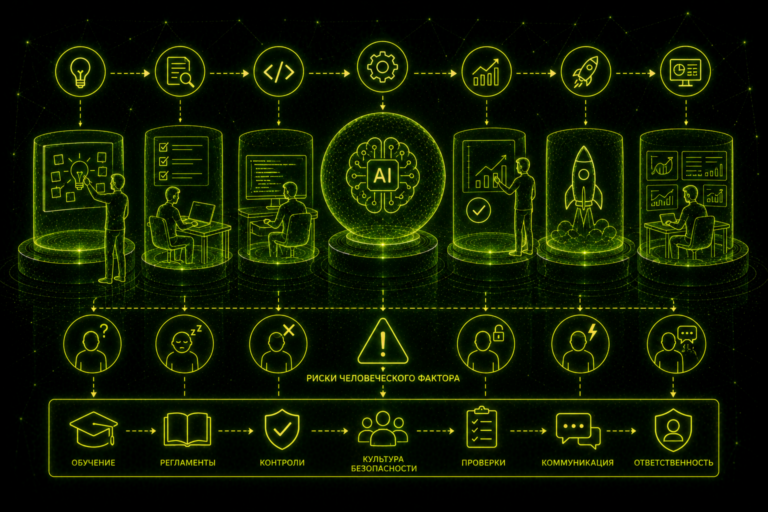
Why Digital Transformations Fail, How to Handle Team Resistance, and How to Get a Real Return on AI Projects
In recent years, artificial intelligence has become a new line in the strategy. The board expects faster results and lower costs. Meanwhile, competitors show off demos, and falling behind starts to feel dangerous.
So the company picks a platform, signs a contract, and launches pilots. It hires a team and builds presentations. Then, six to nine months on, an uncomfortable truth surfaces. The technology exists, the budget is gone, but a managed result is nowhere in sight. Now the AI sits in the company either as a showpiece or in narrow use, quietly breeding resistance.
AI Is Not an IT Project
Today, most companies can buy neural models, integrations, and infrastructure. Yet a hidden conflict unfolds around what AI truly changes: the arrival of another source of “truth” in the organization.
Any automation shifts business processes and the boundaries of authority. However, AI does this especially sharply. After all, it steps into decisions that people once made in the “gray zones.”
Before, responsibility stayed subjective and blurred — “that’s how it’s done,” “everyone does it this way,” “we decided from experience.” After AI arrives, though, an awkward question appears: who answers for the result and for the error?
Here, the system often picks the “safe” option. It either keeps AI out of decision-making. Or it leaves AI as an advisor with no real influence. Or it uses AI but hides the actual errors.
All of this signals one thing: the technology simply isn’t built into the management structure. As a result, the AI project turns into an expensive tool that needs constant support and justification — yet delivers no economic effect for the business.
Three Typical Failure Scenarios
Scenario 1. “No Owner of the Result”
The AI initiative hangs between IT, the business, and security. IT owns the rollout, the business owns the effect, and security owns the limits. In the end, though, no one owns the economic result as a whole.
Prototype testing moves along, yet it never turns into a product. Why? Because no one owns the leap from demo to operating model — no one owns the economic effect.
Scenario 2. “AI Threatens Status and Role”
People often read artificial intelligence as a challenge to their competence: “now the algorithm knows better.” Even when no one says it aloud, they still feel the threat.
So resistance appears — not as open protest, but as a rational defense of status. “It doesn’t fit our market.” “We don’t trust it.” “Our clients and processes are special.” “It’s not the right time yet.”
Meanwhile, workarounds emerge. Officially, the AI is in place. In practice, decisions still follow the old path, and the model serves as decoration. So, once again, the economic effect goes missing.
Scenario 3. “The Tool Works, but Feedback Is Switched Off”
AI needs data, feedback, and an honest record of errors. Yet when bad news is dangerous, the system will not report the AI tool’s misses to leadership.
In that case, quality never improves. The model drifts, and the business inherits a tool that operates “in a fog.” From the outside, it looks as if the AI “delivers no effect.” In reality, the effect is never measured honestly, nor carried through into management changes.
Five Personal Risks for Leaders During AI Rollouts
Risk: the “innovation showcase”
“We need to show the market and the board that we ride the AI trend.”
How it plays out in processes: goals give way to activity — prototypes, demos, the number of queries. Instead of a changed business process, you get an AI tool that never reaches production.
Risk: zero tolerance for errors
“If the AI gets it wrong, it hits our control and reputation — better not to risk it.”
How it plays out in processes: informal bans and “mandatory double-checks” creep in. A double loop appears — officially AI, in practice by hand. The model’s errors never get logged as data for improvement, because admitting them feels dangerous. So quality stalls, and the effect vanishes.
Risk: fear of losing status and a monopoly on decisions
“The algorithm must not argue with me or my key people; we can’t hand influence to a model.”
How it plays out in processes: AI stays in the decorative role of “advisor.” Access to data and integrations gets restricted, and critical cases leave the loop. Decisions still follow the old way, while AI props up the status quo for show.
Risk: reactive management (“fires matter more than the system”)
“There’s no time to build a framework now; we need to close the problem fast and show a result.”
How it plays out in processes: the rollout goes piecemeal — scattered chatbots, reports, and “smart” fields, with no single owner and no steady improvement cycle. Data quality degrades, while exceptions and manual workarounds multiply.
Risk: avoiding clear accountability
“If we name owners, conflict and resistance will start; easier to leave it vague.”
How it plays out in processes: no one owns the result and the effect. So errors have no one to “accept” and review, and incidents get hushed up or tossed between IT, the business, and security. Scaling keeps slipping under the phrase “we’re not ready yet,” while support costs grow without a result.
Questions That Reveal the Real Picture Before It’s Too Late
To see reality clearly and avoid tech debt, ask the questions that expose how human-factor risks bite:
- Who loses power or status if AI becomes the standard, and how does that shape adoption?
- What is our most likely workaround: double-checking, ignoring, shifting responsibility, or swapping metrics?
- Who owns data quality and the honest logging of the model’s errors?
- Which decisions will we never hand to AI, and why — risk control or status protection?
- By which three indicators will we see the economic effect?
- Where will a “double loop” appear (officially AI, unofficially by hand), and how do metrics catch it?
Together, these questions bring management clarity and sharpen the accuracy of decisions.
What to Define Before Scaling
To make AI investment manageable, a company needs a few moves that turn technology into effect.
- Name the owner of the result. One owner of the effect, accountable by budget — a specific leader who answers for the economic effect, the metrics, and the shift to standard use.
- Set the boundaries of decisions. Where AI advises, where it suggests, where it acts, and where it stays barred. This cuts fear and uncertainty, and it reduces manual workarounds.
- Build a feedback channel. An AI error is data for improvement, not grounds to punish an employee. After all, if people fear logging misses, the tool’s quality will never improve.
- Define the cost of error and the loss limit. Spell out in the rules which errors are critical, which are acceptable, and what the stop-or-rollback mechanism is. Then it becomes clear how to bring AI into important loops, because the risks are defined and contained.
- Tie the rollout to processes, not to “usage.” Never judge the effect by the number of queries. Instead, measure the effect by the change in the cycle: speed, quality, time, cost, and fewer repeated errors.
AI Pays Off Where a Company Can Manage Roles and Information
Here is the good news: most AI-transformation failures are reversible. In this case, failure means the absence of a system — an owner, clear lines of responsibility, feedback channels, performance metrics, and a risk limit.
Once these elements are defined, resistance drops on its own. People finally see what changes, what stays, who answers, and how errors get logged.
In that structure, AI becomes an amplifier of control. It speeds up decisions, lowers operating costs, raises service quality, and makes the company’s risk profile more predictable.
For the CEO, this means access to a more accurate picture of reality — and to the grounds behind the decisions teams make, to the “truth.” That, in turn, means a lower cost of error. Artificial intelligence cannot replace management. Yet it sharply raises the cost of a poor management system — and just as sharply raises the payoff once that system is built.