Personal
Risk Management

What Is Personal Risk Management?

Personal risk management is a system for managing risks that arise from a leader’s role and decisions. Its purpose is to anticipate where the current management model conceals danger. In other words, it looks at decision quality and speed. Moreover, it covers reputation, status, career resilience, and income.

Table of Contents

What It Affects

In large businesses, managing risk is standard practice. Companies track financial, legal, operational, and market risks. Additionally, each type has its own reports, committees, and control procedures.

However, the most expensive risks arise closer to the center of command. They form around the person who makes the key decisions.

An owner shapes the business through strategy, budget, and metrics. But they also set the speed of decisions and the quality of discussions. Furthermore, they define the attitude toward bad news. As a result, they set the acceptable level of disagreement. Beyond a certain point, these factors affect income, deadlines, teams, and reputation.

Why Personal Risk Management Matters

The higher the position, the greater the cost of a wrong decision. A specialist’s mistake usually stays inside the task. Meanwhile, a function head’s mistake affects a process or a budget. In contrast, an owner’s mistake can change the trajectory of the company.

The central difficulty is this: at the top level, risk rarely looks like a mistake. Instead, it looks like a strength:

  • makes decisions quickly
  • holds a high standard
  • keeps control of what matters
  • defends their function
  • has no tolerance for weak execution
  • demands precision
  • takes responsibility onto themselves

All of this can be an advantage. For example, it works well during growth or crisis. Then the context changes. The company scales. Functions multiply. Consequently, disagreements sharpen and the cost of error rises.

At that point, the old management style produces side effects:

  • speed turns into a hasty bet on one scenario
  • control creates dependence on a single decision center
  • a high bar hides bad news
  • self-interest collides with company interest
  • caution turns into a loss of momentum
  • confidence turns into a weak grip on reality

This is how personal risk emerges. A leader’s strength keeps working. Nevertheless, under new conditions it starts to cause damage.

The Main Danger

The most expensive personal risks stay invisible for a long time. A company discusses processes, people, markets, and budgets. Yet a leader’s management style is often left out. Especially when that leader is strong and successful.

Therein lies the trap. What brought the business to its current scale can limit the next stage. Consider these examples:

  • At first, an owner’s control protects quality. Later, it becomes a constraint.
  • In a crisis, firmness stabilizes the system. Over a long horizon, it dampens initiative.
  • Initially, betting on strong people delivers results. Afterward, it creates dependence on a few figures.
  • Amid uncertainty, confidence holds the team together. Unchecked, it leads to strategic error.

Personal risk becomes dangerous under one condition. The leader still sees their habits as a source of stability. Meanwhile, the business already pays a hidden price. Specifically, that price appears as forgone income, lost time, and departing talent.

Therefore, personal risk management shows the link between a management model and its consequences.

How to Manage Personal Risks

The work begins with one question. What recurring consequences arise around my decisions and my role? From there, the inquiry follows five steps.

1. Identify the assets at risk.
A leader holds several key assets. These include decision authority, management effectiveness, and reputation. When personal risk intensifies, one of these assets weakens.

2. Find the recurring patterns.
A single incident may be a coincidence. In contrast, repetition points to a mechanism. For instance, decisions are delayed and problems are raised late. Thus, repetition reveals where the system has adapted to the leader.

3. Tie it to a business cost.
Personal risk becomes manageable once its price is visible. For example, late escalation raises the cost of fixing things. Similarly, hands-on control slows scaling. At this stage, what matters is the consequence, not the intent.

4. Define the early signals.
Every personal risk has warning signs. Typically, informal approvals grow in number. Also, the same deviations recur across the business. Notably, these signals appear before financial losses.

5. Build protective mechanisms.
Personal risks can be managed through specific frameworks. As a result, a leader gains a more accurate picture of reality.

What It Gives the Business

For an owner, it reveals where personal involvement creates dependence. A CEO sees which habits shape information quality and trust. At the senior executive level, it protects authority and reputation. The business gains visibility into hidden causes of losses before a crisis.

Ultimately, personal risk management becomes part of leadership quality itself.

Picture of Tatiana Illarionova-Zervas
Tatiana Illarionova-Zervas

I work at the intersection of human factors risk management, HR, psychoanalysis, and strategic IT projects. I support business owners and senior executives, helping them uncover hidden personal, career, and business risks.

I develop concepts, methodologies, and AI tools that improve the quality of management decisions in complex systems.

I believe lasting results emerge when hidden risks are turned into opportunities for growth and manageability.

Risk Identification
Internet resources:

Contact us

Связаться с нами

 Restoring control over the situation
CAUSES
  • Recurring failures: collapsed deals, poor decisions
  • Negotiations and prolonged conflicts: partners, colleagues, clients
OUTCOME
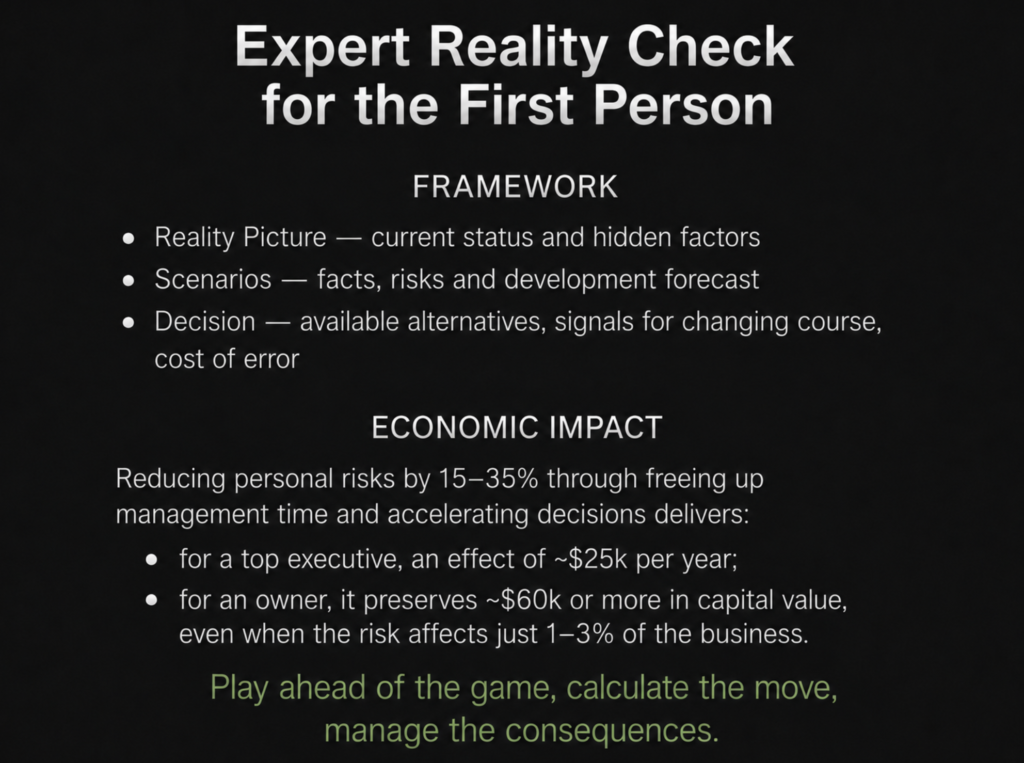
  • Reduced risk-response time by ~15–35%
  • A stabilization plan and risk overview of the situation
TERMS
  • from $750 USD (two hours)

We speak the same language of responsibility and follow these principles:

  • Direct feedback
  • Measurable impact
  • Confidentiality
PROFESSIONAL DEVELOPMENT
  • Human Factors
  • Safety Management System (SMS)
  • Aviation Security
  • Aviation Psychology
  • Air Transport Operations Management
click the file to view it
INTERNATIONAL TRAINING
  • Certification (membership): OPO (Moscow, 2011), ECPP (Austria, 2019)
  • Training under Professor Markus Fäh (Switzerland, 2012)
  • Training under Dr. Giuseppe Civitarese (Italy, 2012)
  • Training under Michel de M’Uzan, Murielle Gagnebin, Alain Gibeault (France, 2010)
  • Training under Charles Sass (Belgium, 2009)
  • Training and supervision under Franco De Masi (Italy, 2012)
  • Training under Fulvio Mazzacane (Italy, 2014)
click the file to view it

The need to reduce Human-Factor Risks

CAUSES
  • Recurring operational losses, incidents, and missed deadlines
OUTCOME
  • ~30% reduction in recurring losses and the cost of errors and failures
  • ~20–25% faster processes
  • A forecast of where human-factor risks will materialize
TERMS
  • Preparation based on the company’s data, incidents, and internal regulations
  • Online/ Offline/ Hybrid
  • Determined after discussing the request
High-stakes urgent situations
CAUSES
  • “In-the-moment” risk:
    • a deal,
    • a promotion,
    • an information leak,
    • a breakdown of agreements,
    • pressure from partners, colleagues, or management
OUTCOME
  • Decision-making logic
  • Probable scenarios factoring in risks
  • ~10% faster decision-making
TERMS
  • from $400 USD (one hour)

Ongoing Support, an Independent Perspective

CAUSES
  • A series of significant decisions over the course of a year: deals, transitions, scaling, expanding influence, new companies, new markets
  • Decisions made under pressure and time constraints, new challenges, a high cost of error
OUTCOME
  • A personal risk matrix and an early-signal radar
  • Review of situations before and after key events
  • Risk detected before turning into losses in ~35% of cases
TERMS
  • Stage 1 (mandatory): building the risk matrix
  • Stage 2 (ongoing support): shadow participation in events or weekly meetings
  • Online, Offline
  • Annual subscription
  • From ≈ $33,000 with 100% prepayment
  • Up to ≈ $36,000 with partial prepayment
Блог будет скоро доступен
Пока ознакомьтесь с материалом на этом ресурсе 

Refreshing Your Personal Strategy

CAUSES
  • Recurring personal losses: deadlines, finances, relationships
OUTCOME
  • ~10–15% greater probability of achieving your goals
  • Aligned actions and minimized risks
TERMS
  • A preliminary meeting
  • Online/ Hybrid
  • From $9,600 (10 sessions of 1.5 hours each) — 100% prepayment

Working through business cases with an eye to personal risks and the way errors are perceived

CAUSES
  • Reversals of decisions already made, repeated revisions
  • Impulsive reactions during failures, missteps
OUTCOME
  • ~15% less time spent on making and revising decisions
  • Methods for analyzing errors and failures under pressure
TERMS
  • Advance registration for a closed group of 4–5 people
  • In person: 4 sessions of 4 hours each over 4 weeks (one month)

  • From $10,000 — 100% prepayment

Greater control over your goals

CAUSES
  • Increase the probability of achieving long-term, global goals
OUTCOME
  • ~15% greater focus on achieving global goals
  • Real-time risk management as events unfold
TERMS
  • Preparation of a sprint format based on preliminary artifacts — using Trello/YouGile
  • Online or in person
  • From ≈ $5,100 (12 one-hour sessions) — 100% prepayment

Проверка соответствия услуг задачи до выбора формата:

ПРИЧИНЫ
  • оперативный анализ ситуации, развилок, переговоров, конфликта
  • вопросы по форматам Виста для осуществления выбора
РЕЗУЛЬТАТ
  • контуры ситуаций, возможные развилки и скрытые риски
  • рекомендация по дальнейшему формату и возможные действия
УСЛОВИЯ
  • онлайн, офлайн
  • от 20,000₽ (1 час) – 100% предоплата
PROFESSIONAL RECOGNITION
  • Letter of Appreciation from ICAO (Ireland, 2015)
  • Letter of Appreciation from the Minister of Transport of the Russian Federation (2016)
  • Certificate of Merit from the CEO of Aeroflot Airlines (2013)
  • Certificate of Merit from the CEO of AeroMASh AB (2015)
click the file to view it
ENTREPRENEURSHIP & INNOVATION
  • Risk Management and Internal Control (2017)
  • Startup Launch Accelerator (B2C, 2024)
  • Incubator Program for Product Go-to-Market (2025)
  • Startup Launch Accelerator (B2B, 2025)
click the file to view it
MBA & Crisis Management
  • Graduate Certificate in Business Administration (University of North Alabama, USA, 2018)
  • The 12 Principles of Aviation Crisis Management and Airline Response (Go) Team (Kenyon International Emergency Services, UK, 2016)
  • Enhanced Airline Response Team Training (Kenyon International Emergency Services, UK, 2014)
click the file to view it
ACADEMIC DEGREE
  • Law (specialization: civil law)
  • Psychology (specialization: clinical psychology, psychoanalysis)
  • International Corporate Management (2018 thesis: “Neural Networks as a Corporate Management Tool”)
click the file to view it

Building a Personal Risk Profile

CAUSES
  • Making a high-stakes decision, taking on greater responsibility

  • Derailed plans, mounting costs, pressure from stakeholders

  • Stalled income, scaling, or business relationships

OUTCOME
  • ~10% less exposure to risks and unexpected factors

  • ~20% lower costs from poor decisions and missteps

  • A personal risk matrix and an early-signal radar (success/failure)

TERMS
  • A separate preliminary meeting and preparation of materials
  • Online, in person, or hybrid
  • From ≈ $9,600 (10 sessions of 1.5 hours each) — 100% prepayment 

A holistic business approach, with the option to bring in experts in:

  • Risk management and human factors
  • Large-company leadership
  • Business strategy and PR

Surfacing the unconscious processes that:

  • Distort one’s perception of reality
  • Provoke conflicts over influence
  • Create breakdowns in trust

Analysis of the pressures acting on the leader:

  • Interaction with systems
  • Management cycles
  • Decision-making pressure

We translate the situation into a portfolio of risks:

  • The probability and cost of errors
  • Possible scenarios
  • Checkpoints and conditions

Связаться с нами