AI Risk Radar: The Personal Risks an Owner and a Top Executive Face During Rollout
An AI rollout exposes a leader’s personal risks faster than any crisis. The technology brings to the surface the management defects already present: late escalation, concentrated decisions, intolerance of transparency, an environment chosen to suit the leader.
For an owner, a CEO, and a hired top executive, these risks differ. Different early signals, a different cost of error. Conflating these risks is a management error in itself.
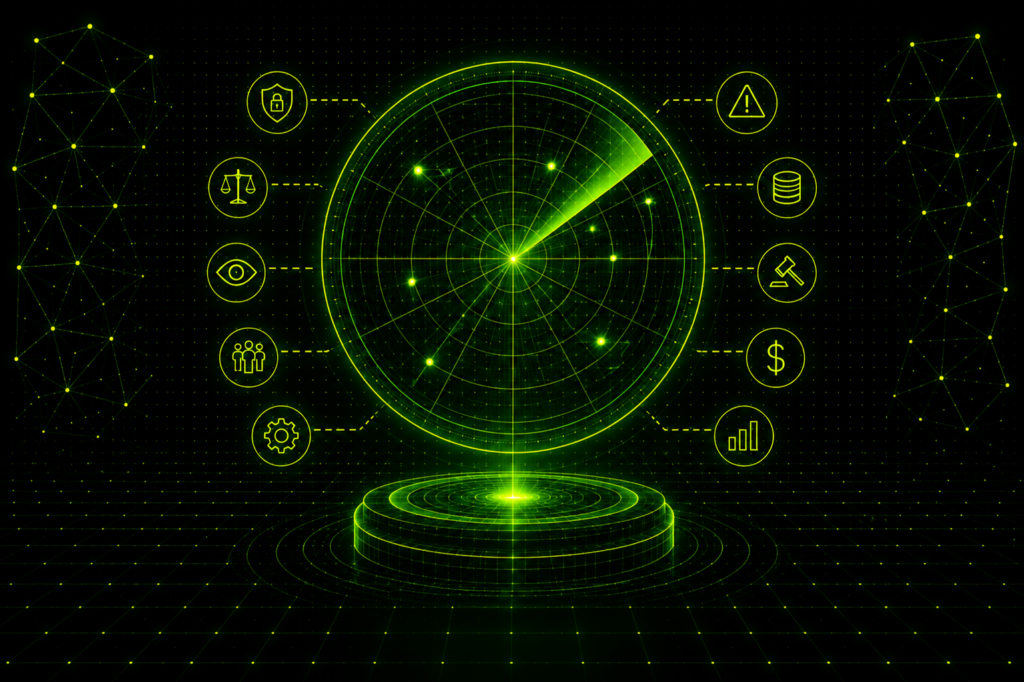
To move these mechanisms from impressions to a measurable picture, the 12-signal AI risk radar is set out below. It assesses the quality of management, which AI brings into view.
The Principle: Technology Scales Whoever Manages It
The Vista TFS method treats a leader’s personal risks as recurring mechanisms through which the probability of loss arises. These include late escalation, concentrated decisions, an environment chosen to suit the leader, and intolerance of uncertainty. They are mechanisms, not character traits.
AI engages these mechanisms at a speed management habits have not adapted to. Where decisions were once concentrated in one person’s hands, AI increases the flow of data requiring that person’s call, and the bottleneck narrows. Where the truth was rationed, AI delivers unrationed data, and the system responds with rejection.
The practical question is therefore specific: which personal risks will AI convert from probability into cost, and how fast?
A Map of the Owner’s Personal Risks
Five risks surface most often in an owner during AI projects. For each: how it shows up, the early signal, and the cost it converts into.
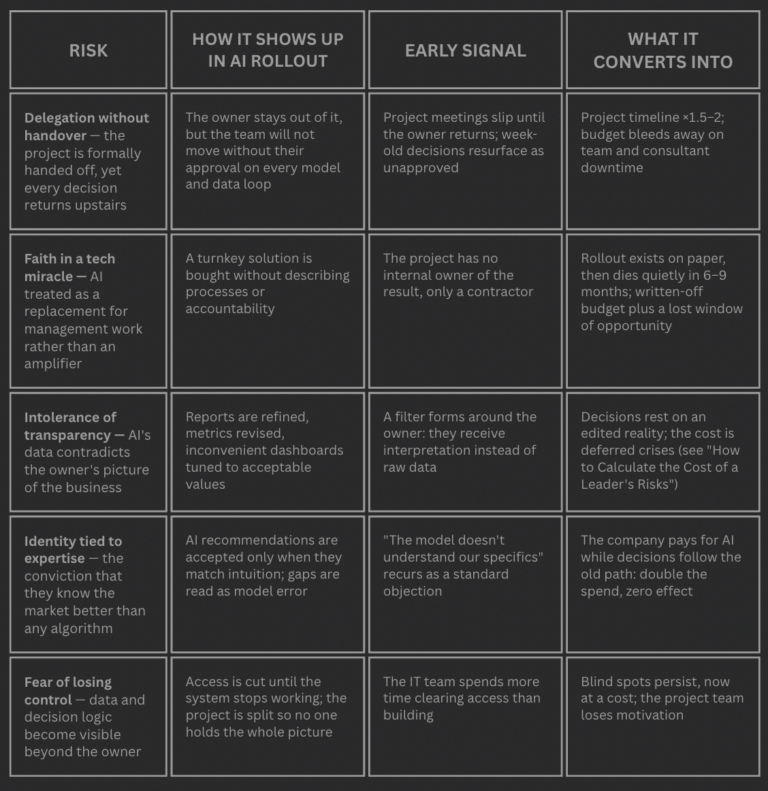
All five owner risks concern the relationship with truth and control. AI does not create them. It shortens the time between a risk and the bill for it.
A Map of the Top Executive’s Personal Risks
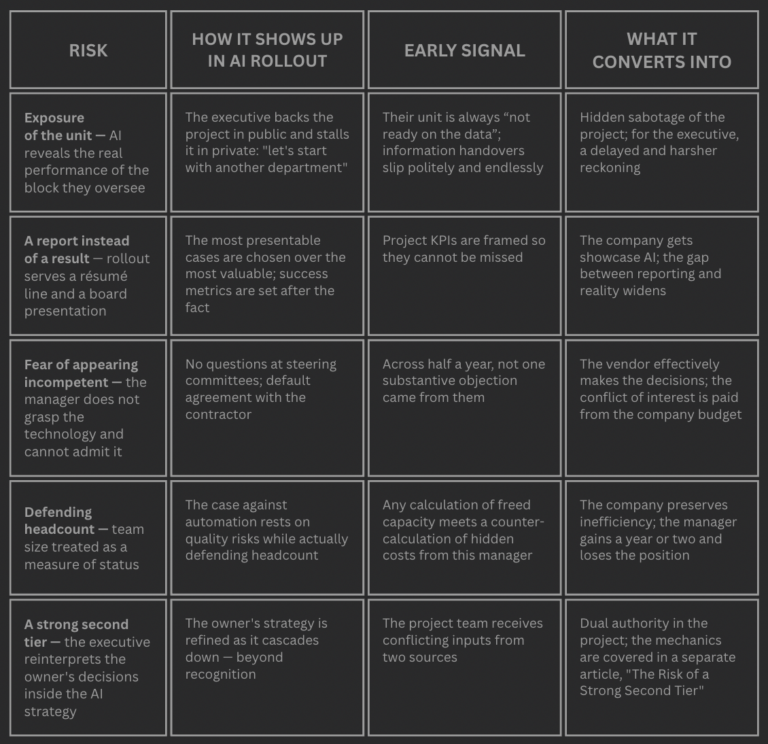
A hired leader — a CEO, an operations or functional director — carries a different configuration. These risks concern position, status, and career safety.
The Third Loop: The Team as the System’s Memory
Beyond the two top figures lies a third loop of personal risks: key mid-level employees. For years, these people carried the manual workarounds that covered process defects. AI rollout carries a concrete risk for them: their irreplaceability was their capital, and AI devalues it.
The response is predictable and rational. Knowledge goes undocumented, specifics get exaggerated, and model training slows quietly. The productive approach treats this as a negotiating position to buy out: convert the status of “irreplaceable operator” into “owner of expertise who trains the system.” This is a question of motivation design before the project starts.
AI Risk Radar: A 12-Signal Diagnostic Tool
The diagnostic follows the logic of the Vista TFS Personal Risk Matrix and assesses observable mechanisms rather than intentions. The radar consists of 12 signals across four loops: accountability, truth, decisions, and motivation. Mark the statements true for the company right now — only honest yes answers count. At the end, you receive a score from 0 to 12 and an interpretation with a sequence of actions.
What to Do with the Result
The Vista TFS method converts risks into a portfolio: probability × cost × early signal × checkpoint. For an AI rollout, the minimum plan follows five steps.
Step 1. Name the owners before choosing a vendor. A contractor entering a company with no internal owners of the result becomes the de facto owner of the project, with every conflict of interest that brings.
Step 2. Run a data amnesty. Declare a period in which real figures — on workload, losses, manual fixes — are accepted without organizational consequences. Otherwise, AI trains on an edited reality, and the output reflects the distortion.
Step 3. Draw up the leader’s personal risk list for the project. From the owner’s map above, select the two risks with the strongest resonance. If none resonate, that is itself a signal pointing to risk No. 3. For each, define the early signal and the person entitled to raise it.
Step 4. Re-sign the contract with key expertise. Before the start, explicitly, in money and status: define what the people who train the system receive.
Step 5. Set a checkpoint at day 90. Repeat the 12 radar questions and compare. Movement along the accountability and truth loops predicts rollout success more reliably than any demo.
An AI project gives a company an X-ray of its own management, usually sought only after a crisis. The question is who reads the image first: the leader or the consequences.
Technology scales whoever manages it. When clarity, accountability, and truth scale across the system, AI becomes a lever. When the leader’s blind spots scale, they become the lever instead.
Related material:
«AI Implementation and Human-Factor Risk Management »